For families

Raise a healthy, confident athlete.

Practical one-page guides for athletes ages 6 to 14, built on the five pillars of whole-athlete development. Save one to your phone, print one for the fridge, or share it with your team parents.
Start here

Three guides to start with

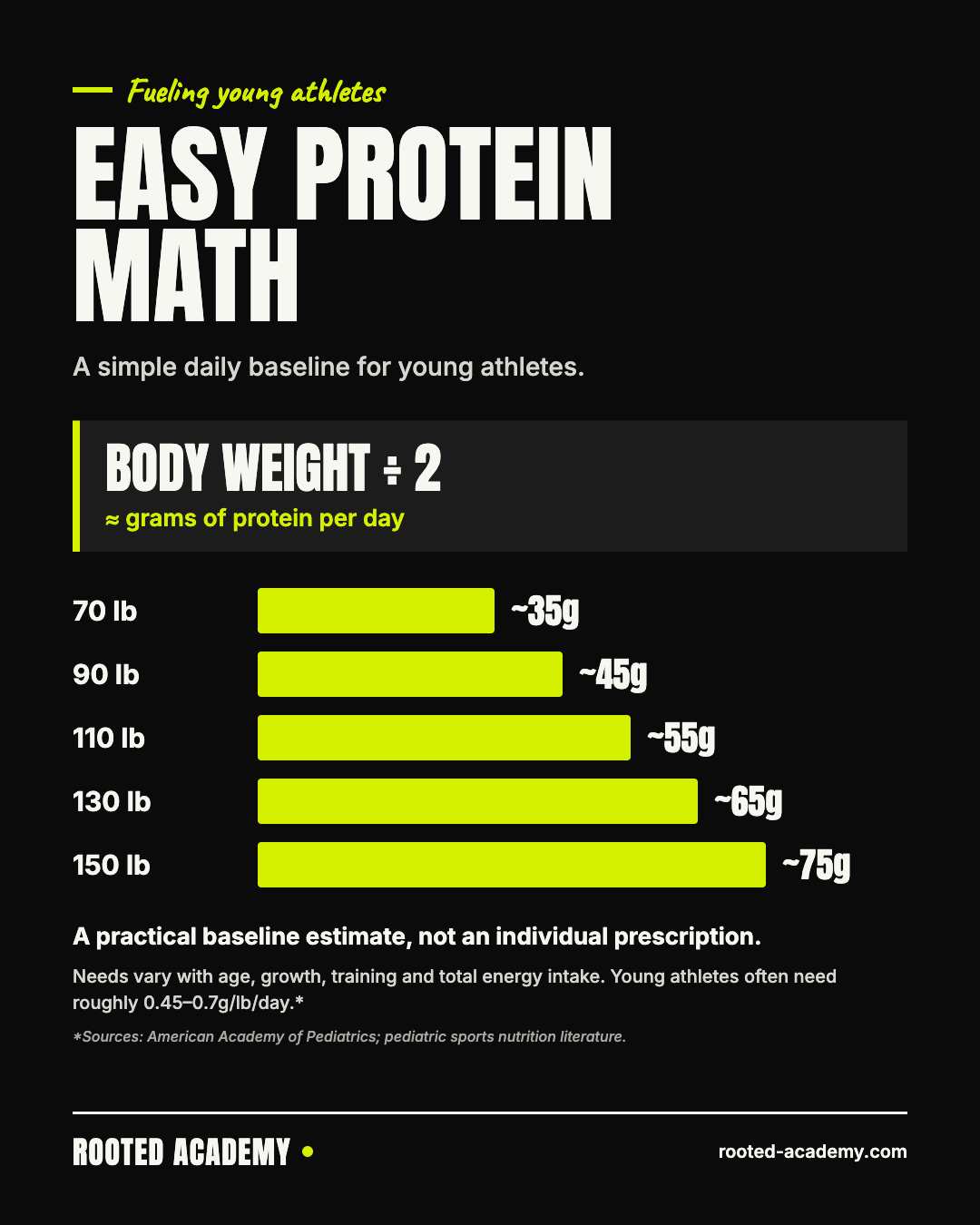
Easy protein math: Body weight divided by 2
PhysicalEasy protein mathBody weight ÷ 2Use it when you're wondering if your athlete gets enough protein.
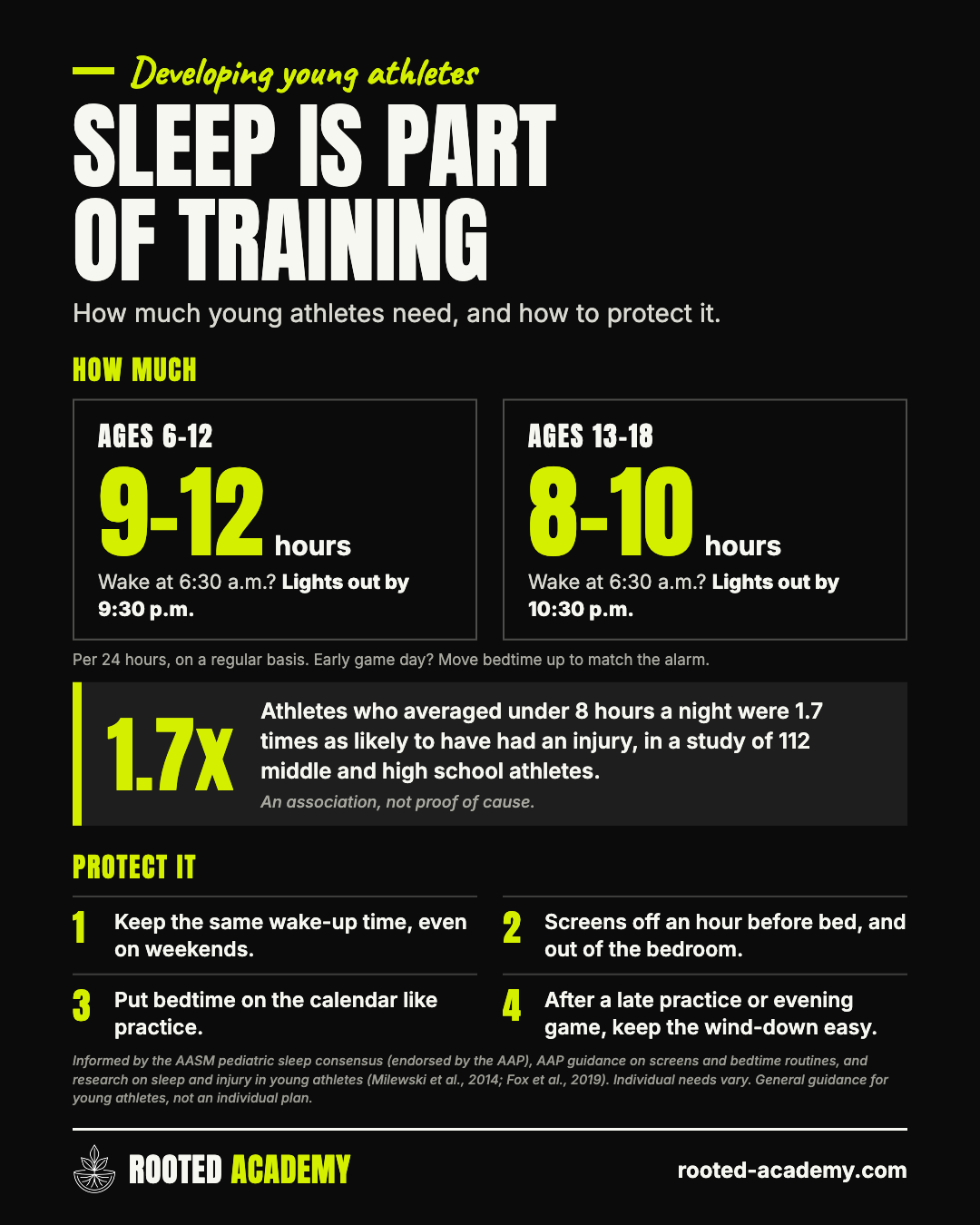
Sleep is part of training: How much young athletes need
PhysicalSleep is part of trainingHow much young athletes need, and how to protect itUse it when the schedule starts eating into bedtime.
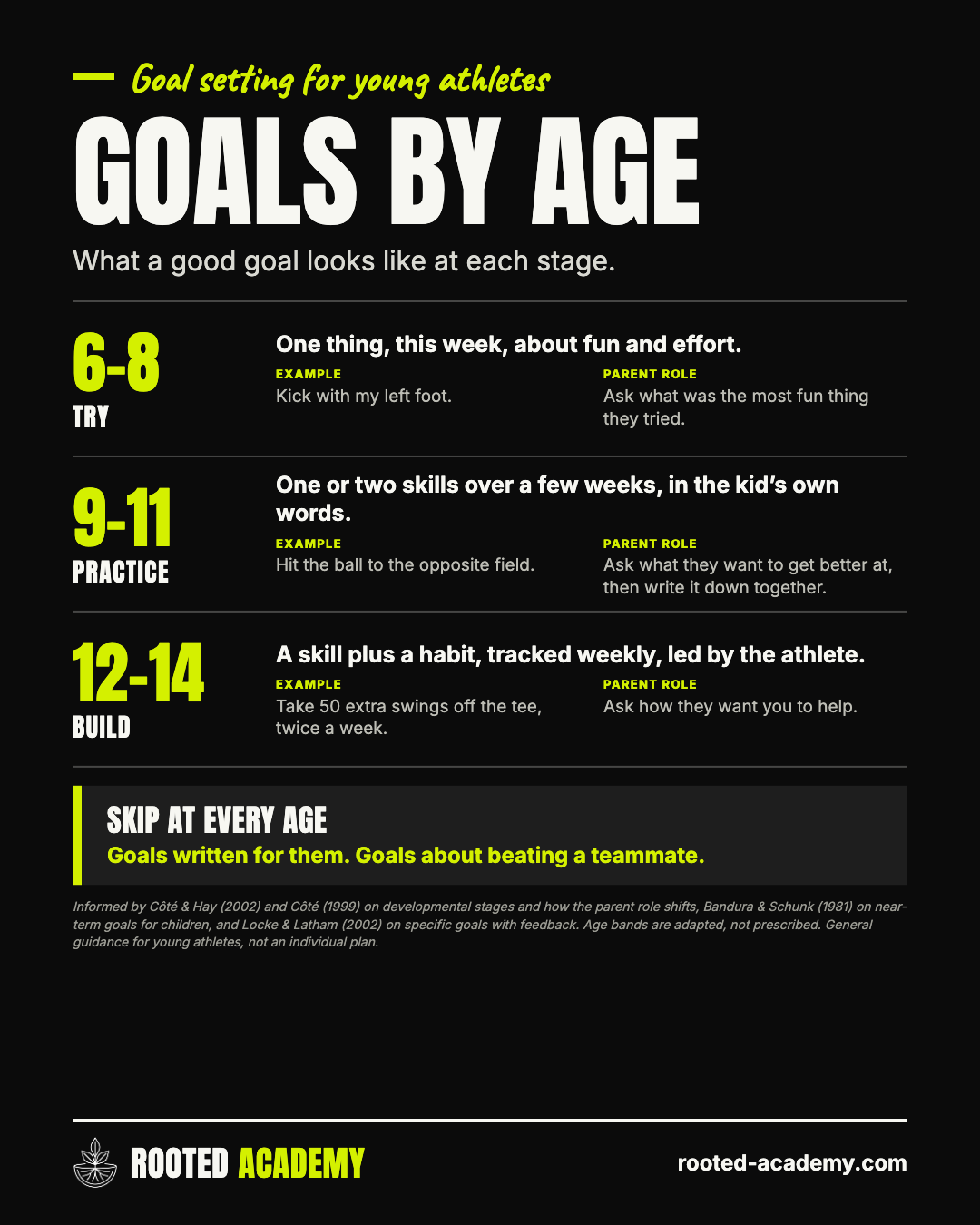
Goals by age: What a good goal looks like at each stage
MindGoals by ageWhat a good goal looks like at each stageUse it at the start of a season, so goals are theirs, not set for them.
Family guides

Find what you need by topic

Guides for athletes ages 6 to 14. Open a topic to see its guides, and each one shows the pillar it builds.

Fueling (12)

Protein, carbs, fat, sugar and hydration for active kids, from everyday meals to game day.

Protein
Easy protein math: Body weight divided by 2
PhysicalEasy protein mathBody weight ÷ 2
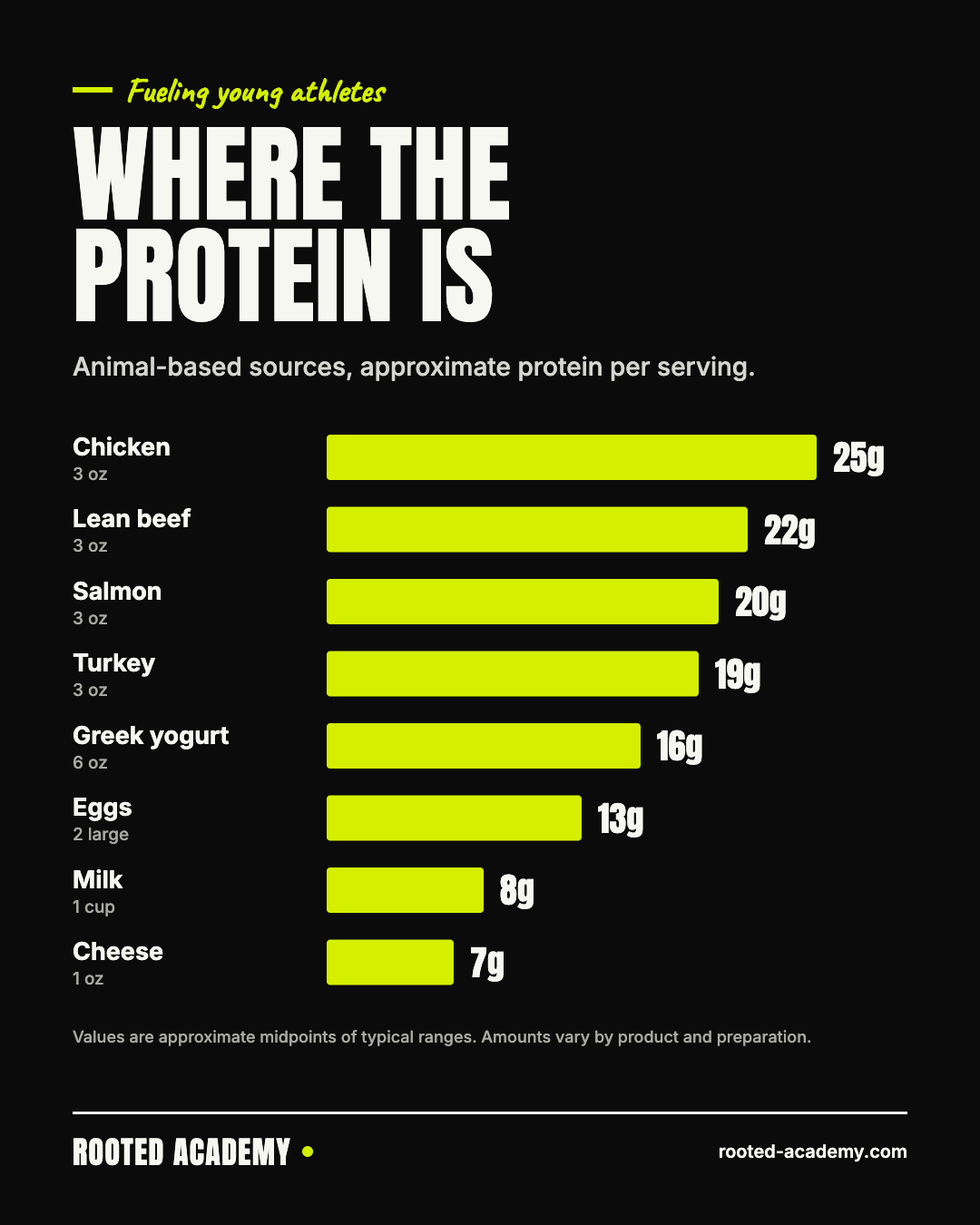
Where the protein is: Animal-based sources
PhysicalWhere the protein isAnimal-based sources
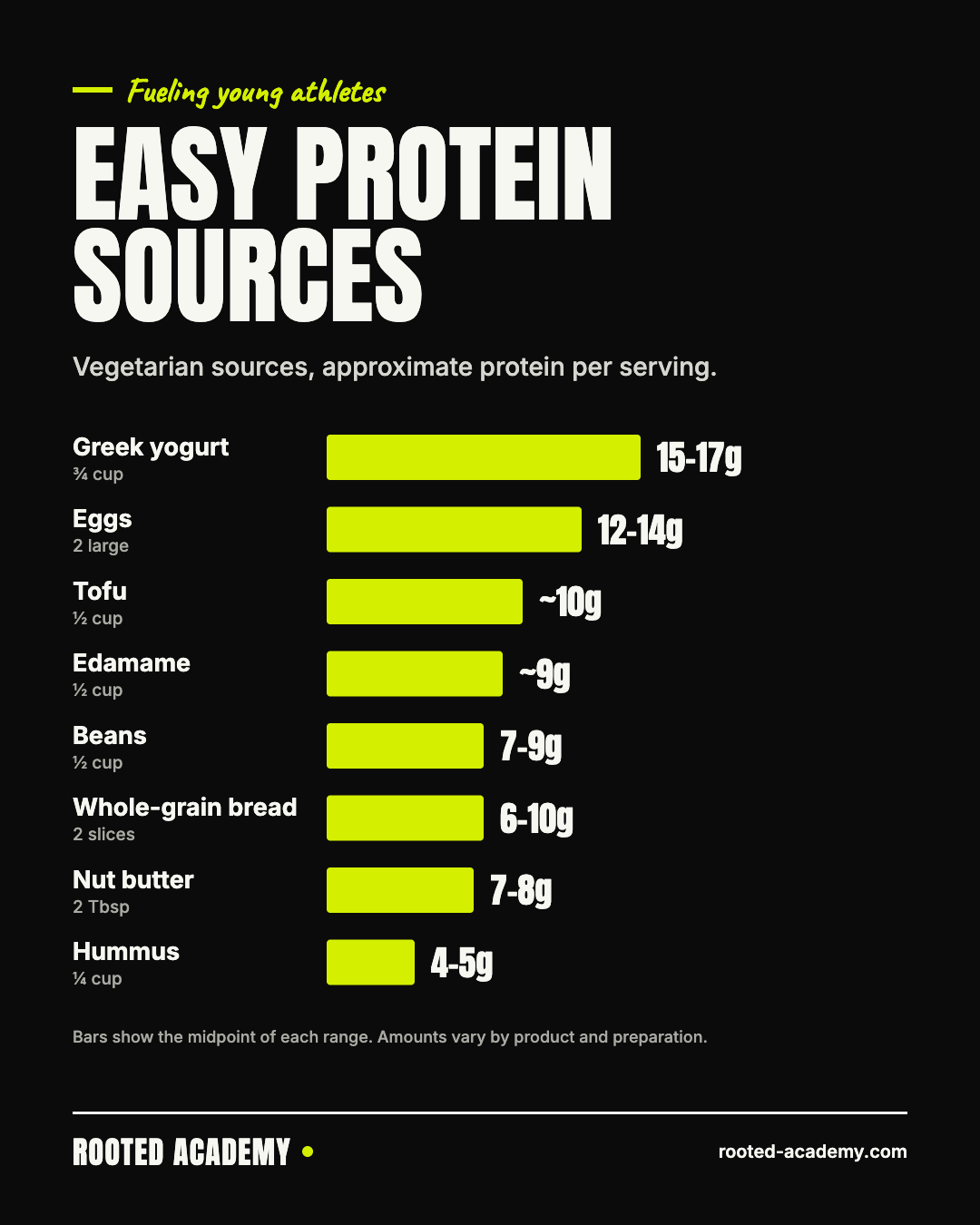
Easy protein sources: Vegetarian sources
PhysicalEasy protein sourcesVegetarian sources

Carbs

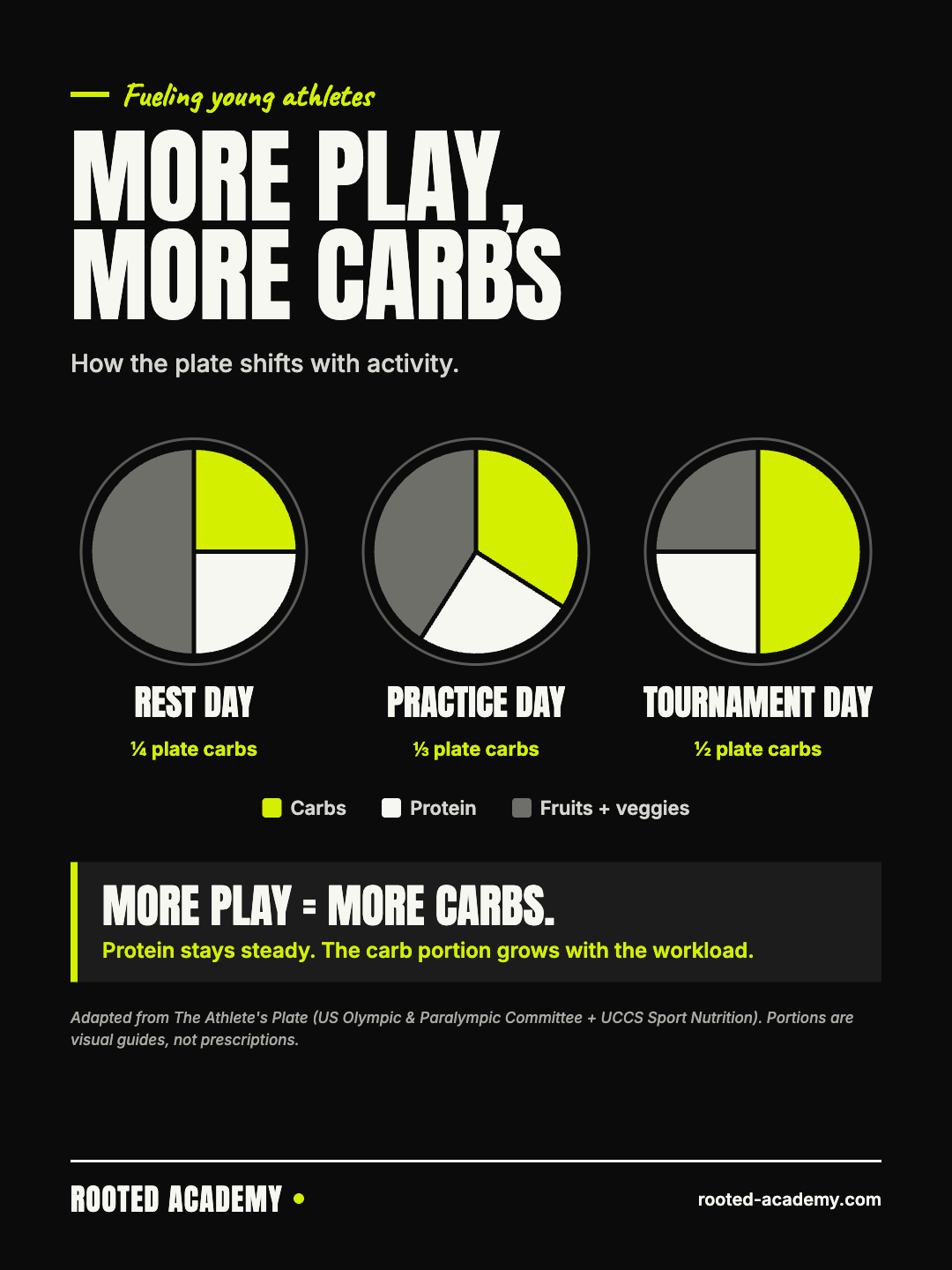
More play, more carbs: How the plate shifts
PhysicalMore play, more carbsHow the plate shifts
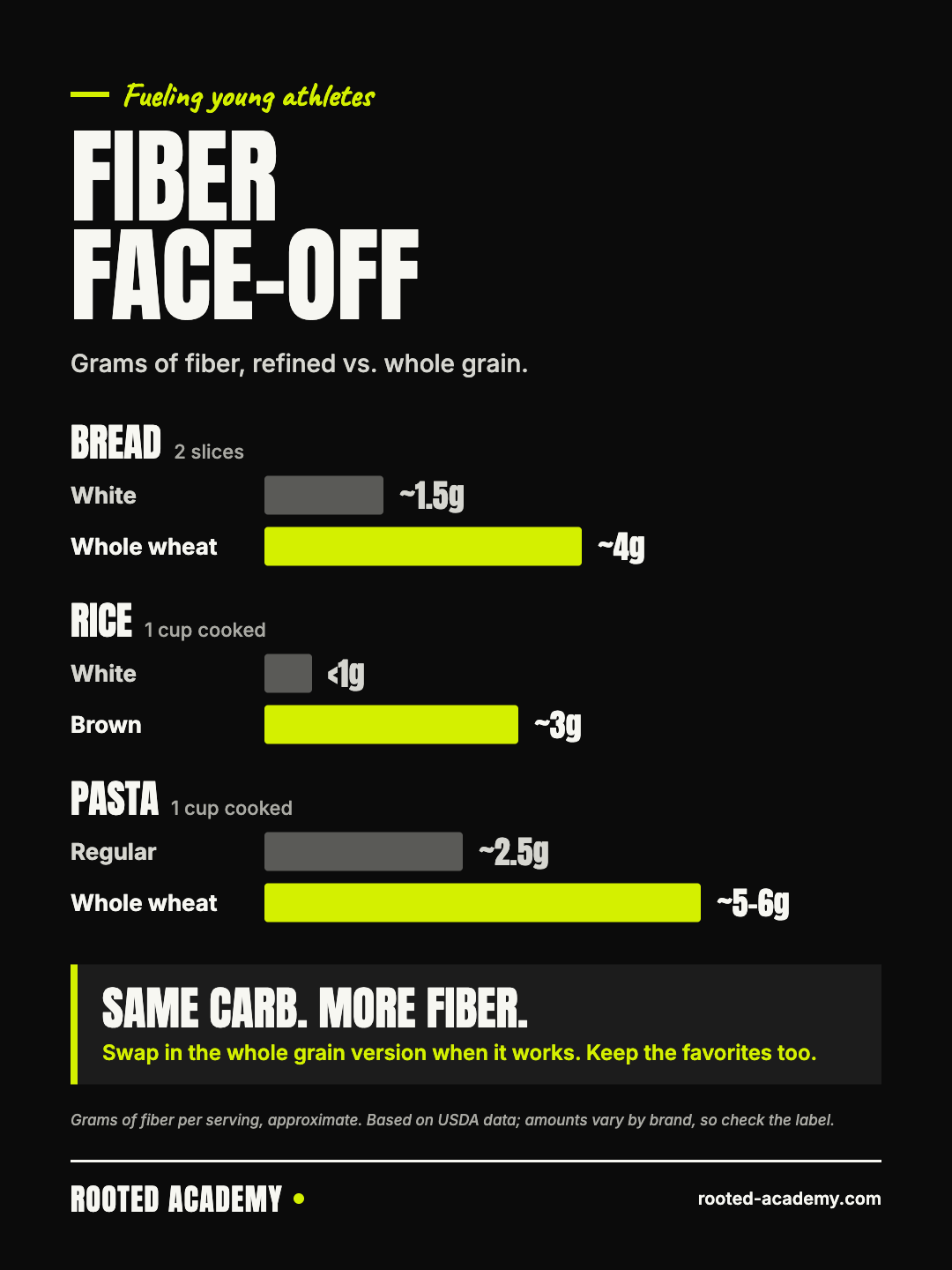
Fiber face-off: Refined vs. whole grain
PhysicalFiber face-offRefined vs. whole grain
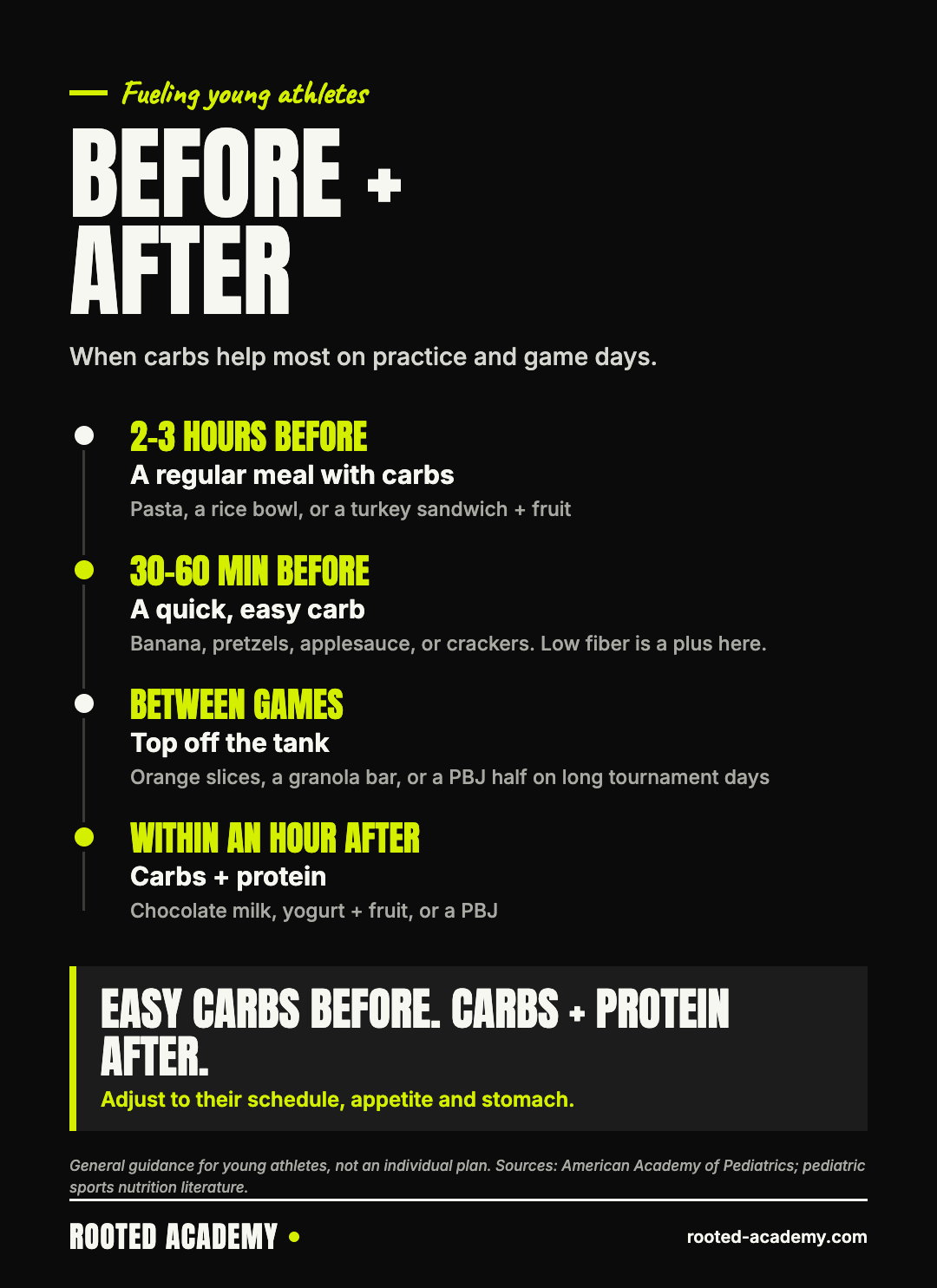
Before + after: Practice day timing
PhysicalBefore + afterPractice day timing

Fat

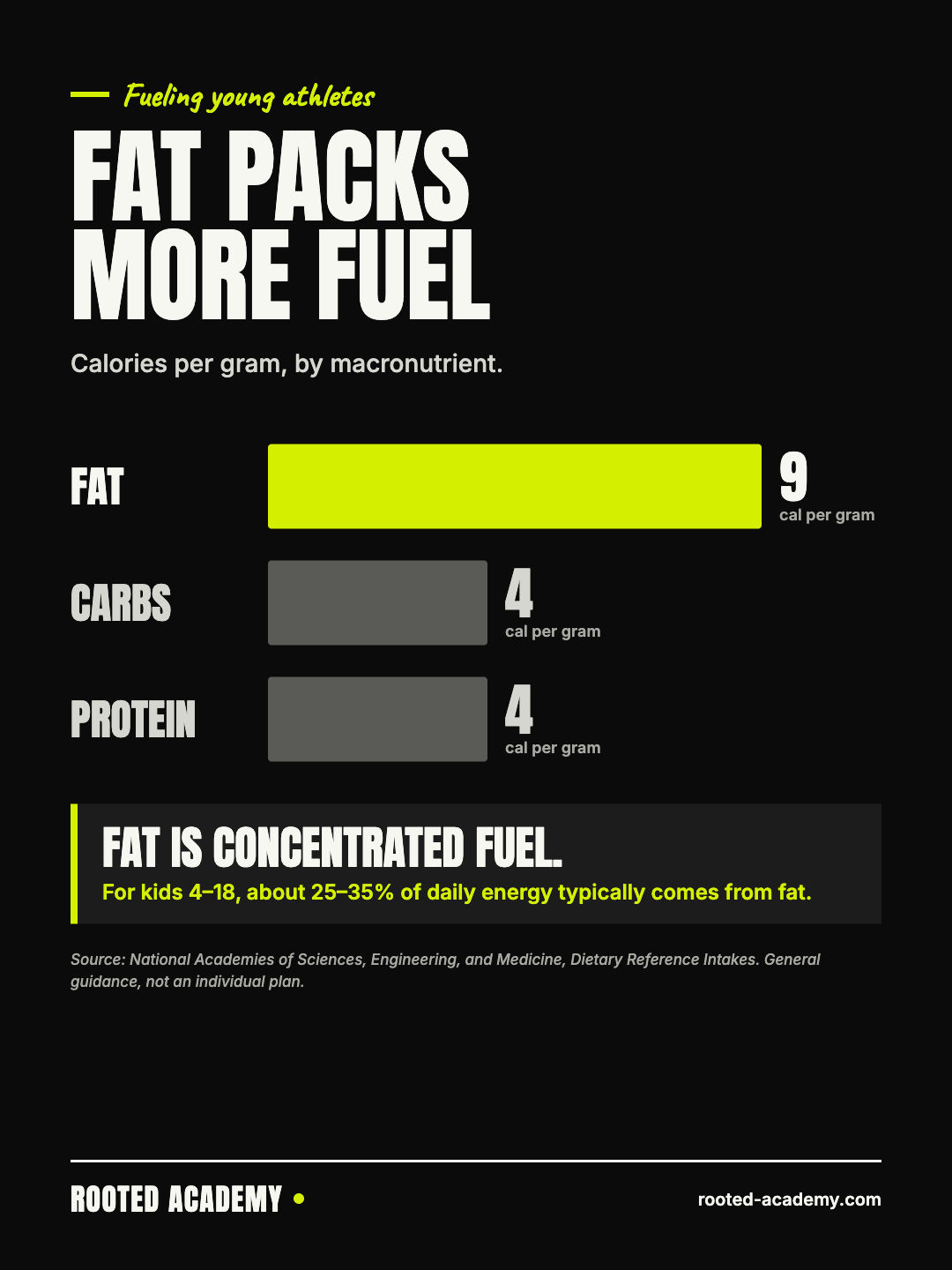
Fat packs more fuel: Calories per gram
PhysicalFat packs more fuelCalories per gram
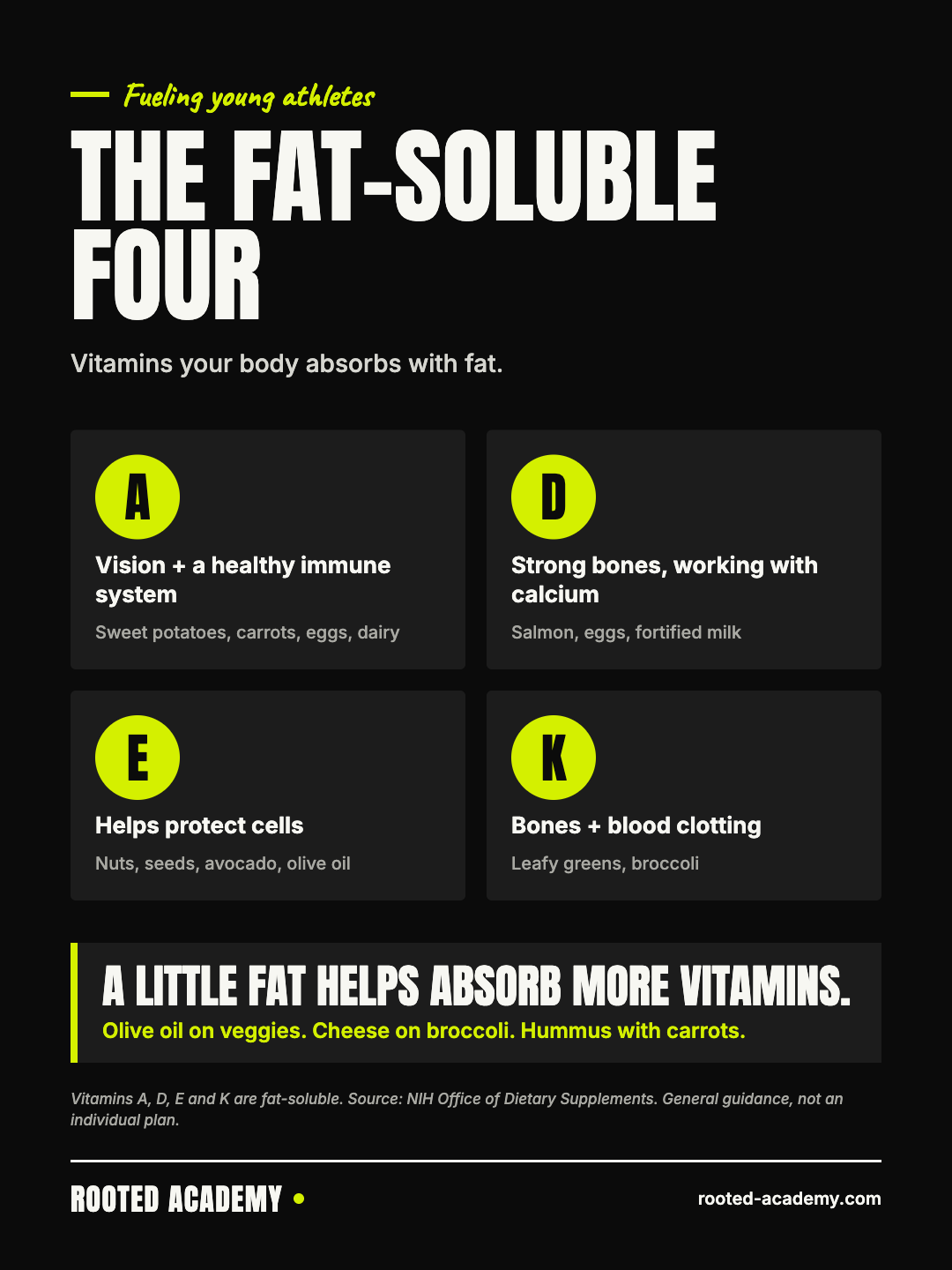
The fat-soluble four: Vitamins A, D, E and K
PhysicalThe fat-soluble fourVitamins A, D, E and K
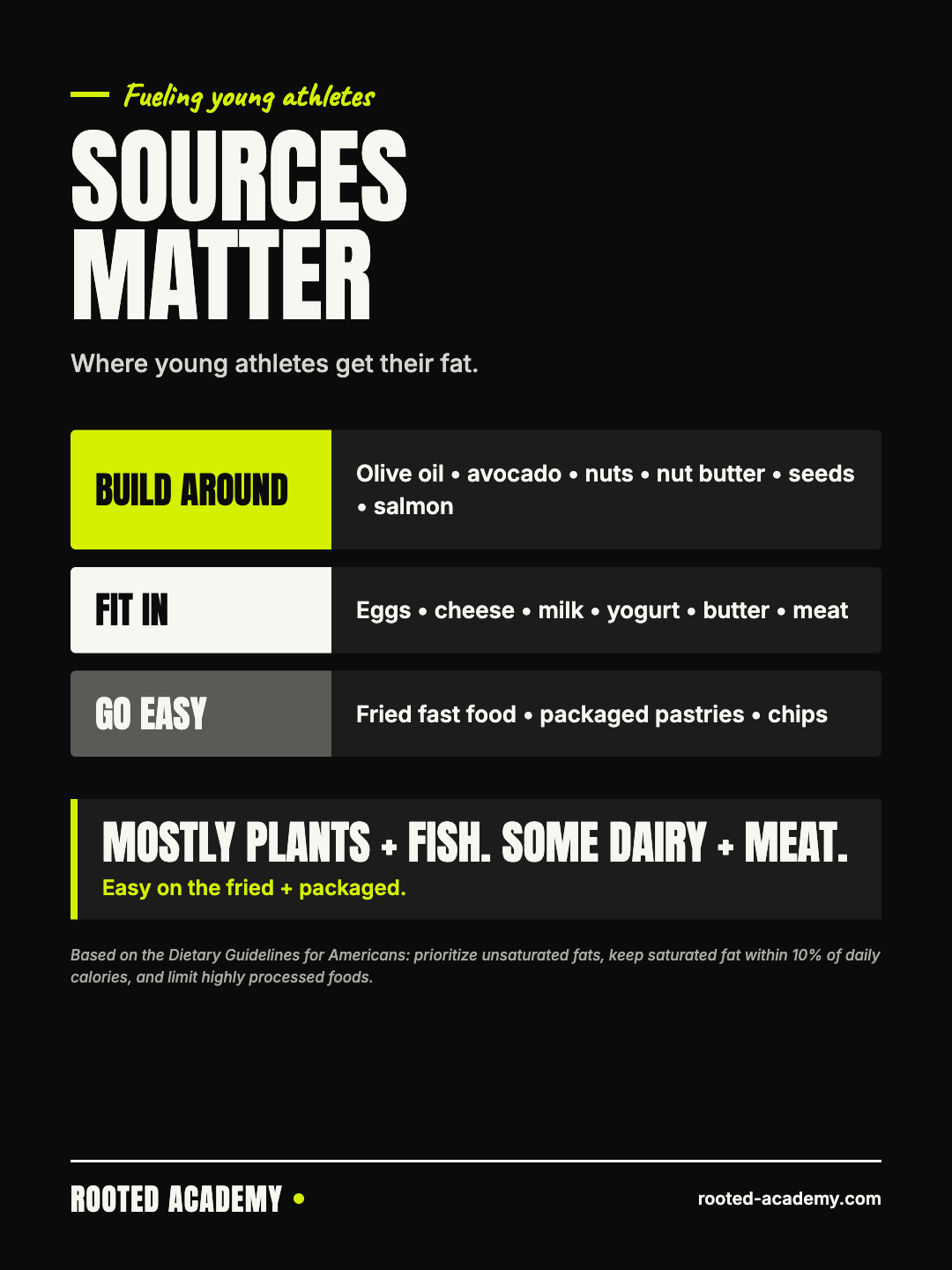
Sources matter: Where fat should come from
PhysicalSources matterWhere fat should come from

Sugar + hydration

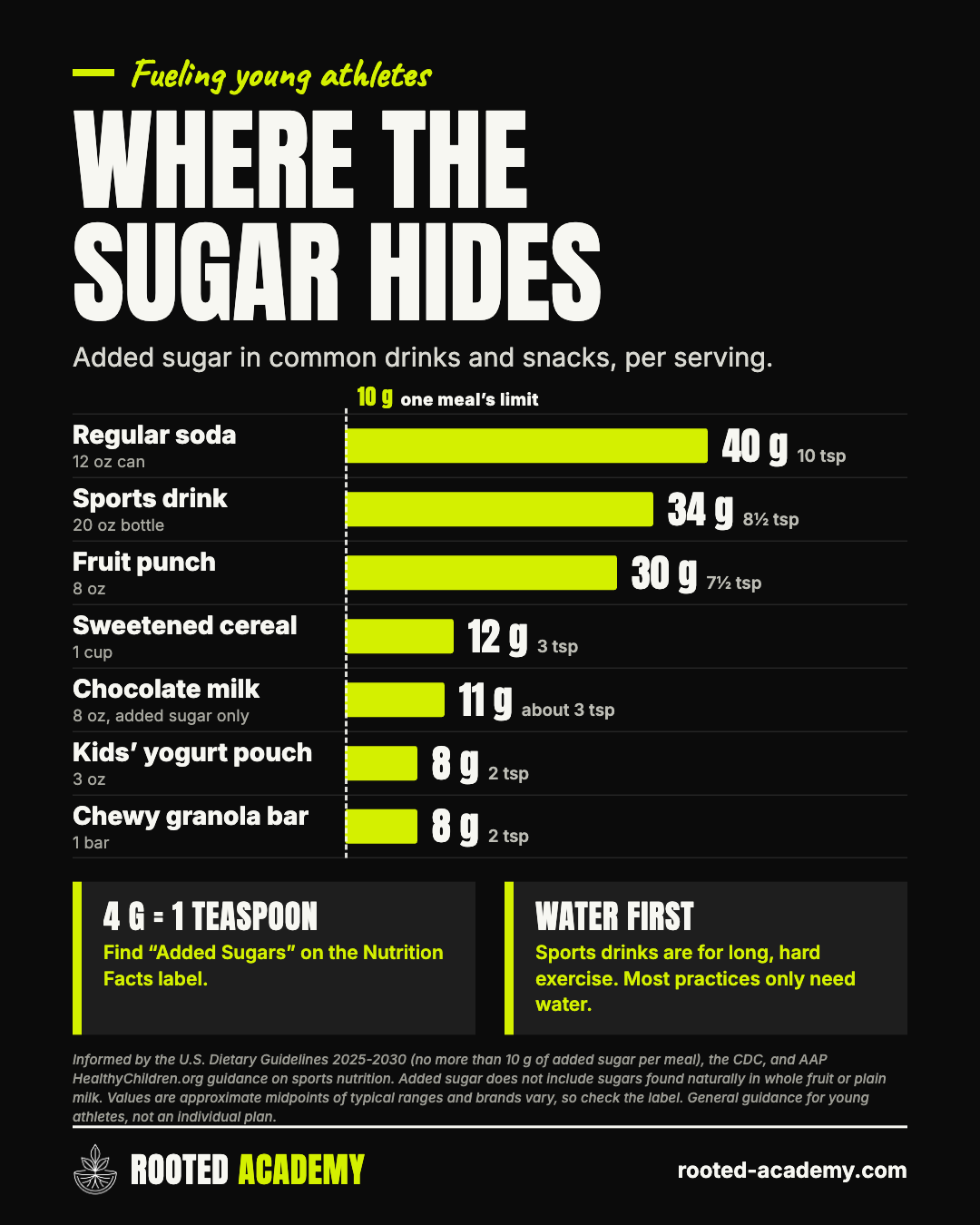
Where the sugar hides: Added sugar in common drinks and snacks
PhysicalWhere the sugar hidesAdded sugar in common drinks and snacks
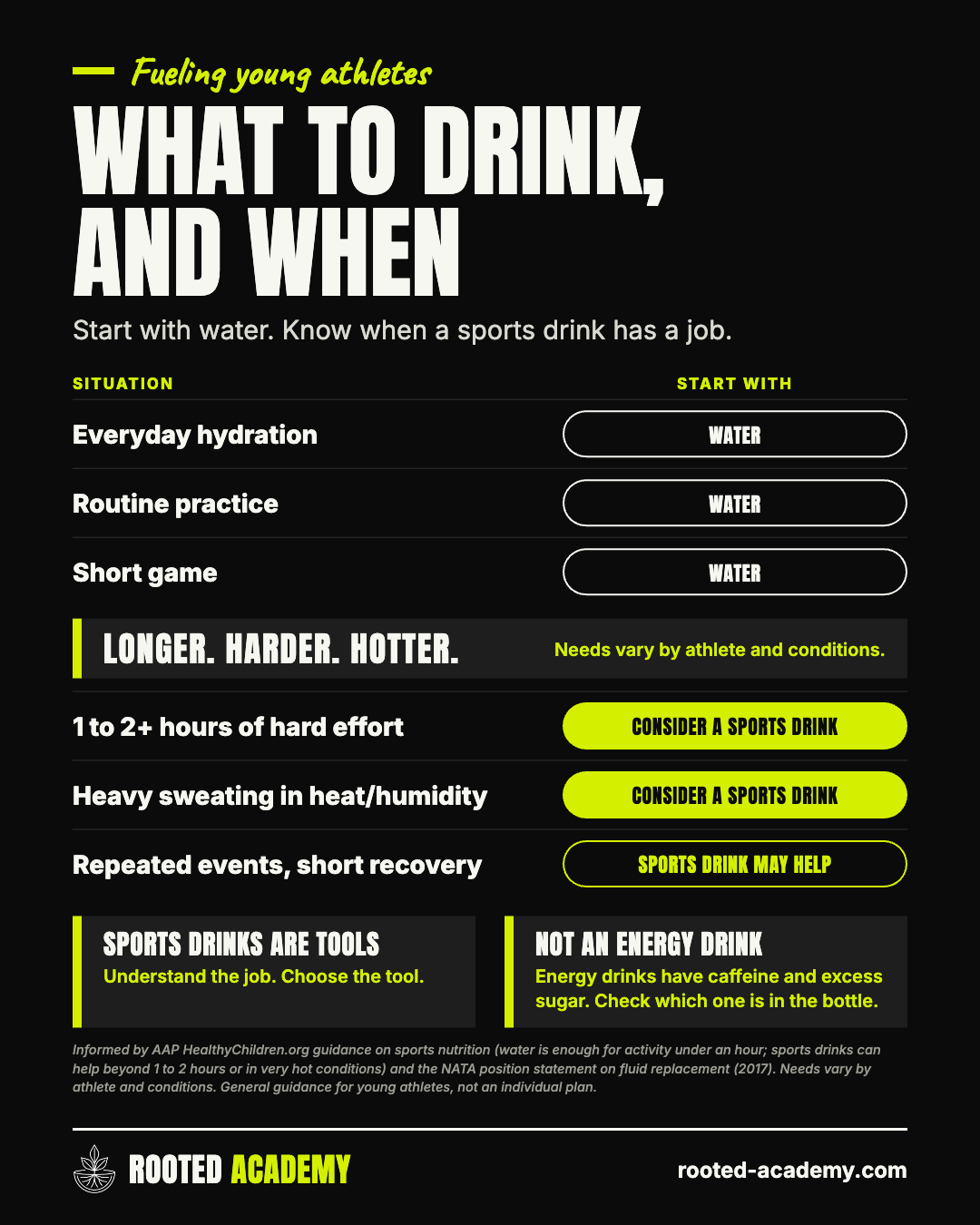
What to drink, and when: Start with water
PhysicalWhat to drink, and whenStart with water, and when a sports drink has a job
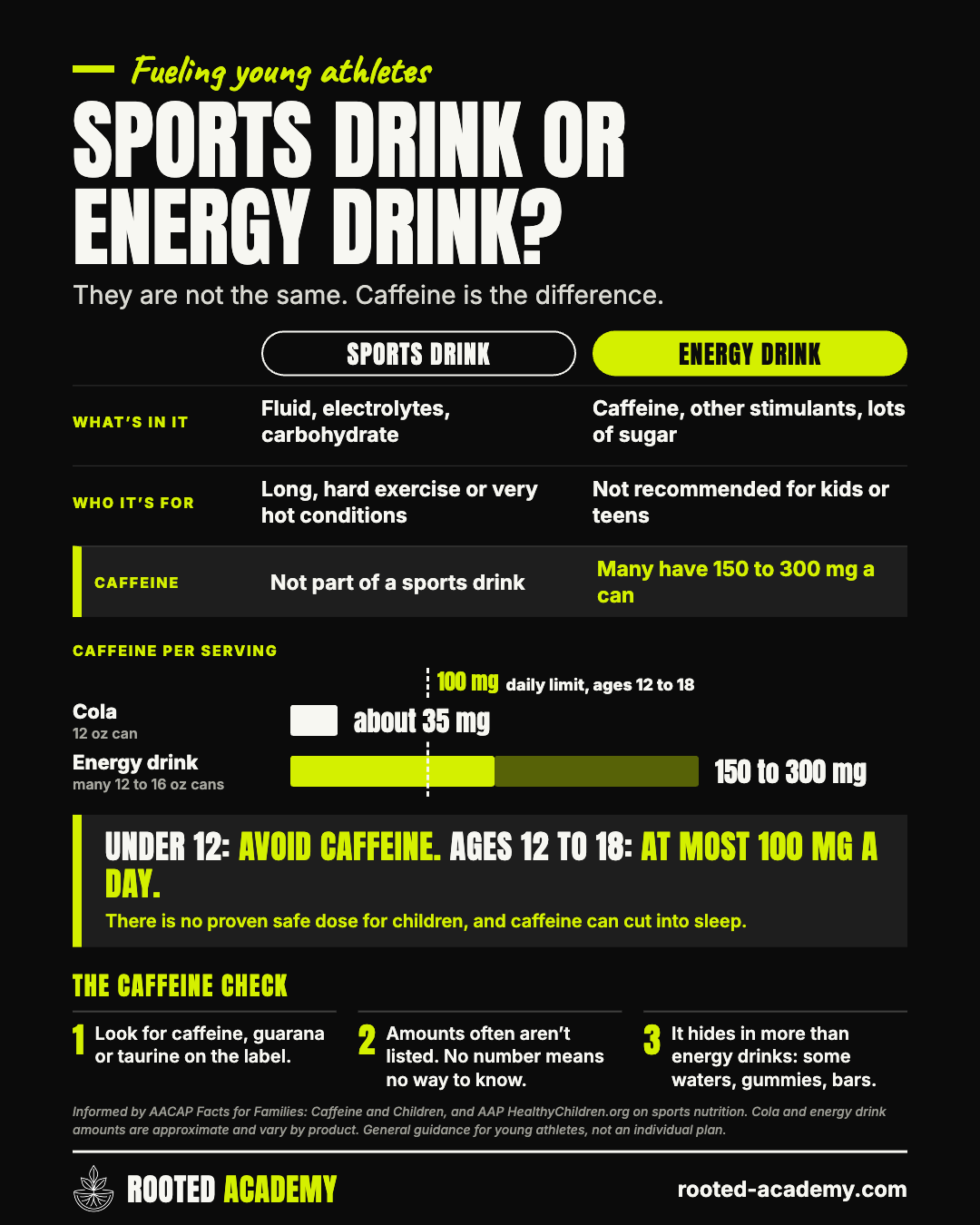
Sports drink or energy drink: Caffeine is the difference
PhysicalSports drink or energy drink?Caffeine is the difference
Sources: Fueling

Protein

  • American Academy of Pediatrics, HealthyChildren.org, sports nutrition guidance for young athletes. healthychildren.org
  • USDA FoodData Central, protein per serving. fdc.nal.usda.gov

Carbs

  • The Athlete's Plate. U.S. Olympic & Paralympic Committee and UCCS Sport Nutrition. swell.uccs.edu
  • USDA FoodData Central, fiber per serving. fdc.nal.usda.gov
  • Kinsella, S. (2017). Sports nutrition for busy families and busy lifestyles. American Academy of Pediatrics, HealthyChildren.org. healthychildren.org

Fat

  • USDA FoodData Central, energy values for fat, carbohydrate and protein (calories per gram). fdc.nal.usda.gov
  • NIH Office of Dietary Supplements. Vitamin A, D, E and K fact sheets. ods.od.nih.gov
  • U.S. Department of Health and Human Services & U.S. Department of Agriculture. (2026). Dietary Guidelines for Americans, 2025–2030. dietaryguidelines.gov

Sugar

  • U.S. Department of Health and Human Services & U.S. Department of Agriculture. (2026). Dietary Guidelines for Americans, 2025–2030. dietaryguidelines.gov
  • Centers for Disease Control and Prevention. Be Smart About Sugar. cdc.gov
  • Kinsella, S. (2017). Sports nutrition for busy families and busy lifestyles. American Academy of Pediatrics, HealthyChildren.org. healthychildren.org

Hydration

  • Kinsella, S. (2017). Sports nutrition for busy families and busy lifestyles. American Academy of Pediatrics, HealthyChildren.org. healthychildren.org
  • McDermott, B. P., Anderson, S. A., Armstrong, L. E., et al. (2017). National Athletic Trainers' Association position statement: Fluid replacement for the physically active. Journal of Athletic Training, 52(9), 877–895. doi
  • American Academy of Child and Adolescent Psychiatry. Caffeine and Children (Facts for Families). aacap.org

Game day + Halloween weekend

  • Castle, J. Gameday nutrition tips for young athletes. Academy of Nutrition and Dietetics, Kids Eat Right (reviewed 2025). eatright.org
  • TrueSport. What to pack in a tournament cooler (via USA Swimming, 2026). usaswimming.org
  • Nationwide Children's Hospital. Tips for a healthier Halloween night. nationwidechildrens.org
  • American Academy of Sleep Medicine. Recommended amount of sleep for pediatric populations (2016). aasm.org
Sleep (1)

How much sleep young athletes need, and how to protect it during a busy season.

Sleep is part of training: How much young athletes need
PhysicalSleep is part of trainingHow much young athletes need, and how to protect it
Sources: Sleep

Sleep

  • Paruthi, S., Brooks, L. J., D'Ambrosio, C., et al. (2016). Recommended amount of sleep for pediatric populations: A consensus statement of the American Academy of Sleep Medicine. Journal of Clinical Sleep Medicine, 12(6), 785–786. doi
  • Milewski, M. D., Skaggs, D. L., Bishop, G. A., et al. (2014). Chronic lack of sleep is associated with increased sports injuries in adolescent athletes. Journal of Pediatric Orthopaedics, 34(2), 129–133. doi
  • Fox, J. L., Sargent, C., Scanlan, A. T., & Stanton, R. (2019). Insufficient sleep in young athletes? Causes, consequences, and potential treatments. Sports Medicine. doi
  • American Academy of Pediatrics, HealthyChildren.org. Healthy sleep habits: How many hours does your child need? healthychildren.org
Strength (5)

When strength training makes sense, what it looks like at each age, and what too much looks like.
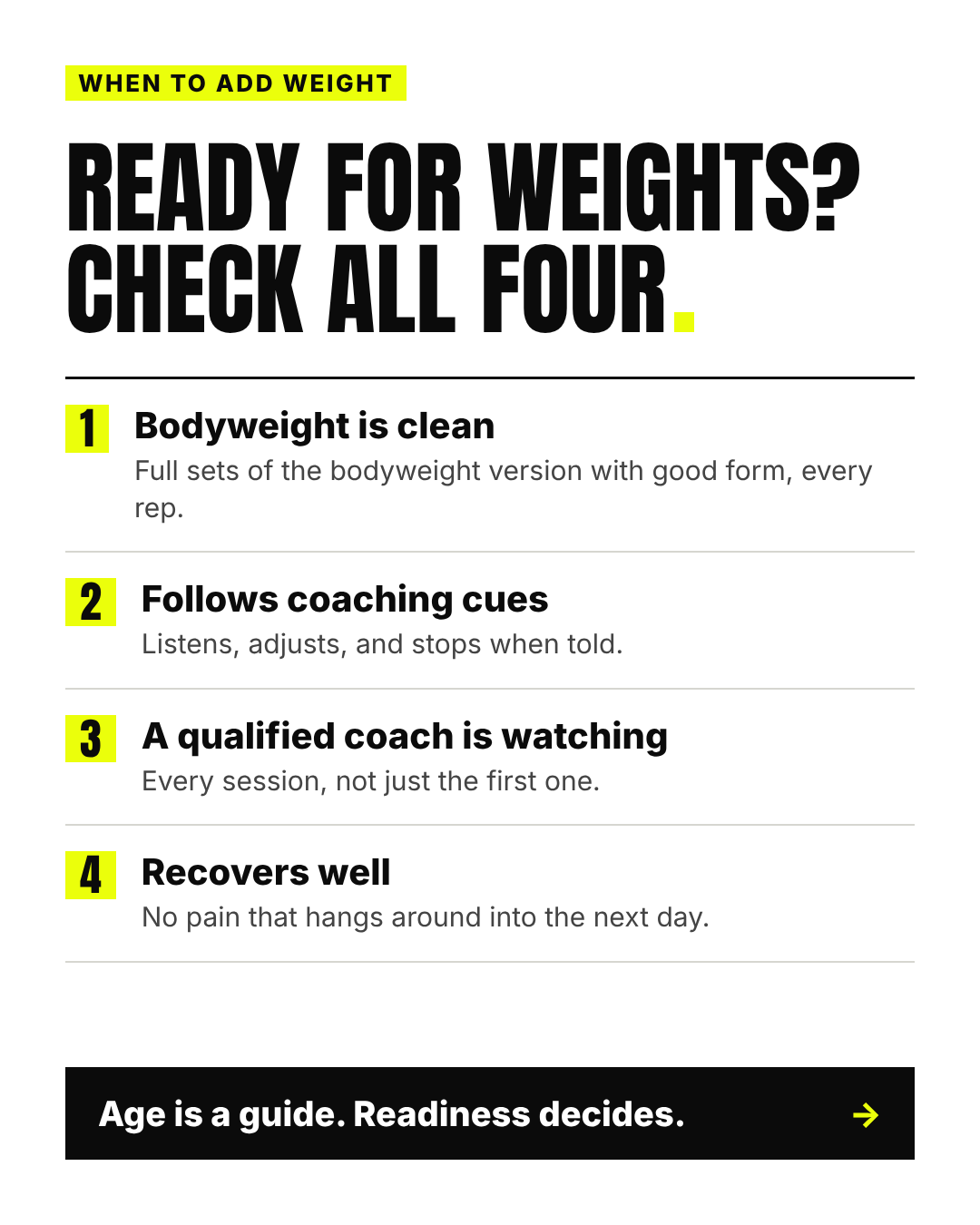
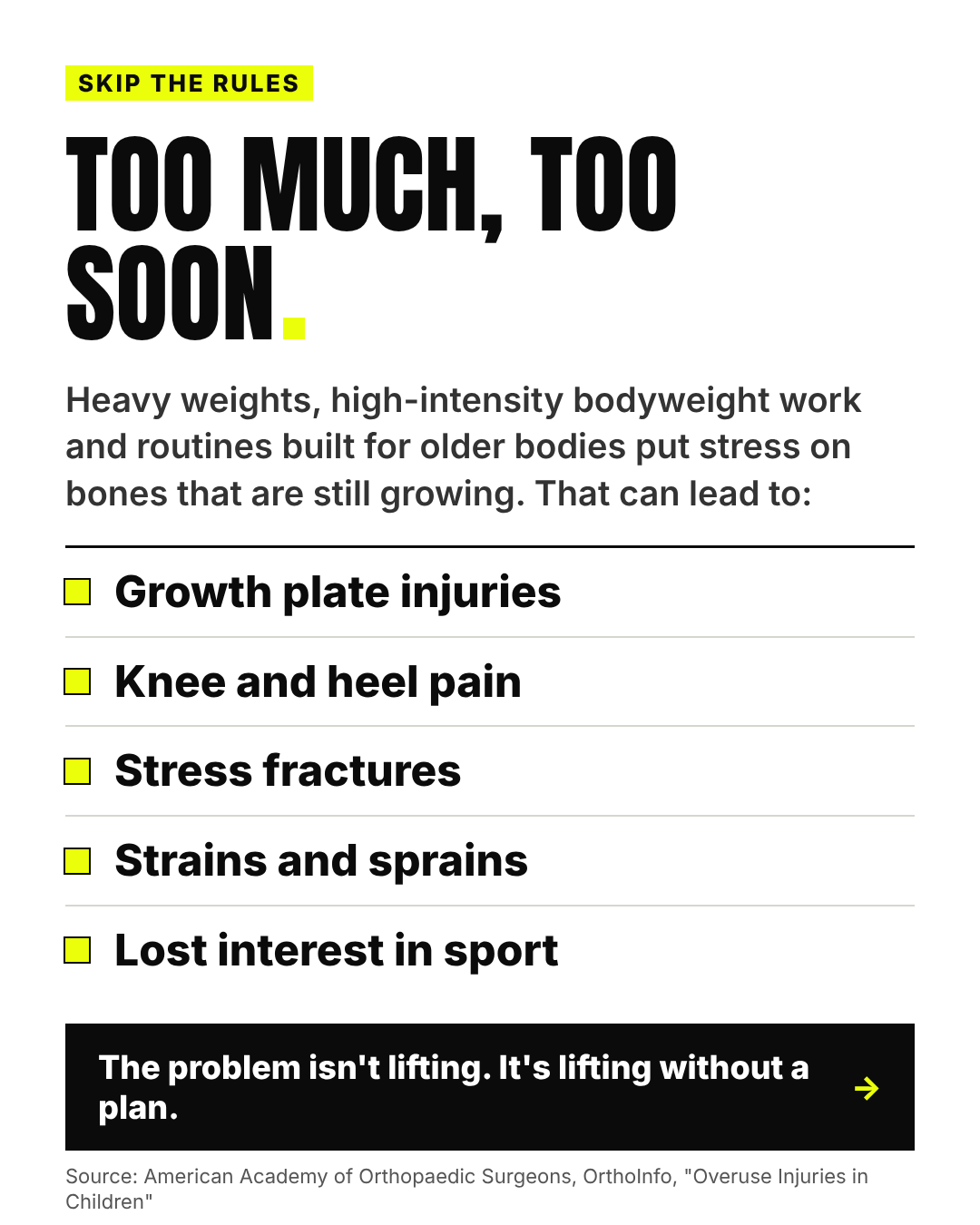
Ready for weights? Check all four
PhysicalReady for weights?Four checks before adding load
Too much, too soon: risks of developmentally inappropriate training
PhysicalToo much, too soonWhat the wrong training does to a growing body
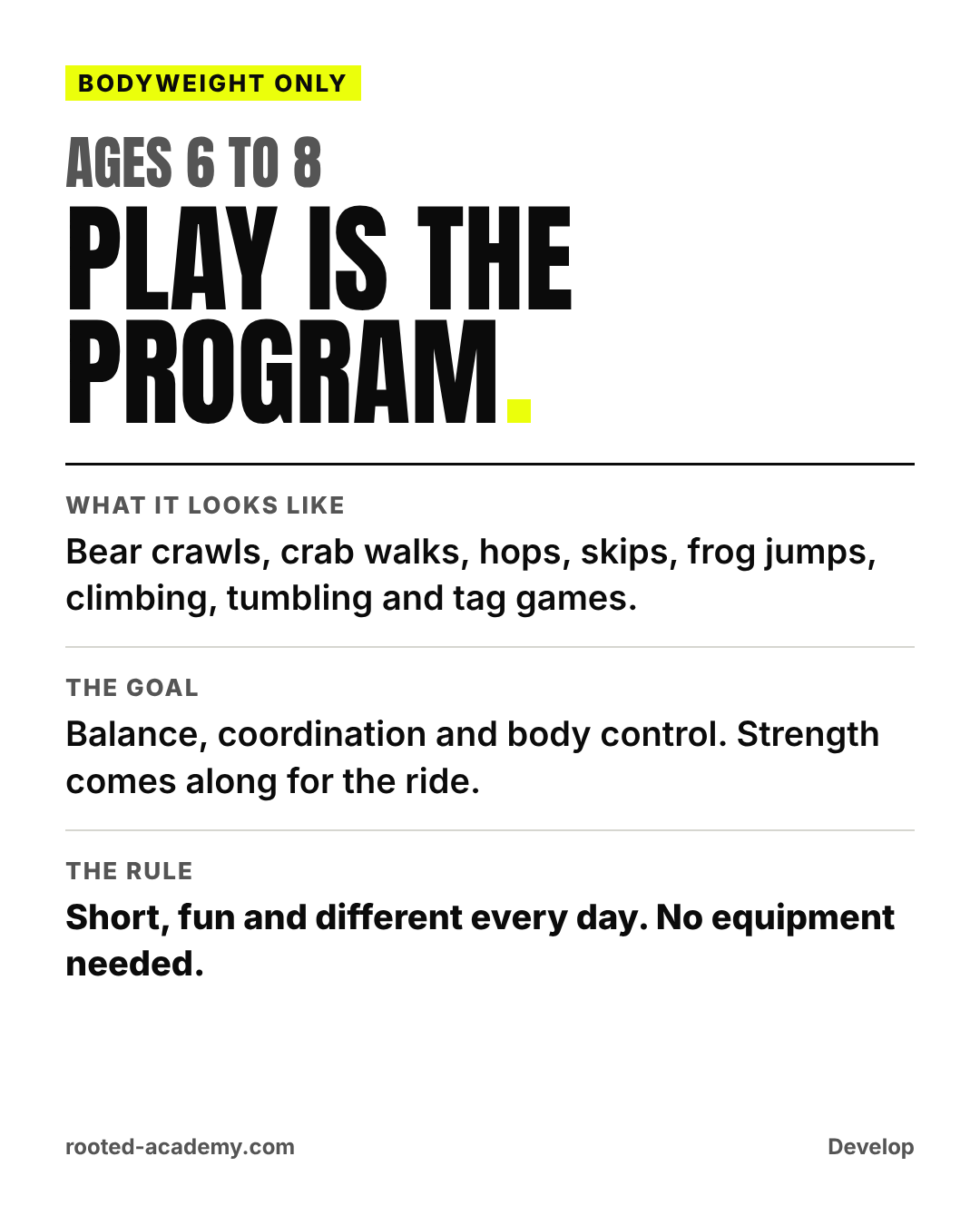
Strength for ages 6 to 8: Play is the program
PhysicalAges 6-8: Play is the programBodyweight only, through games and movement
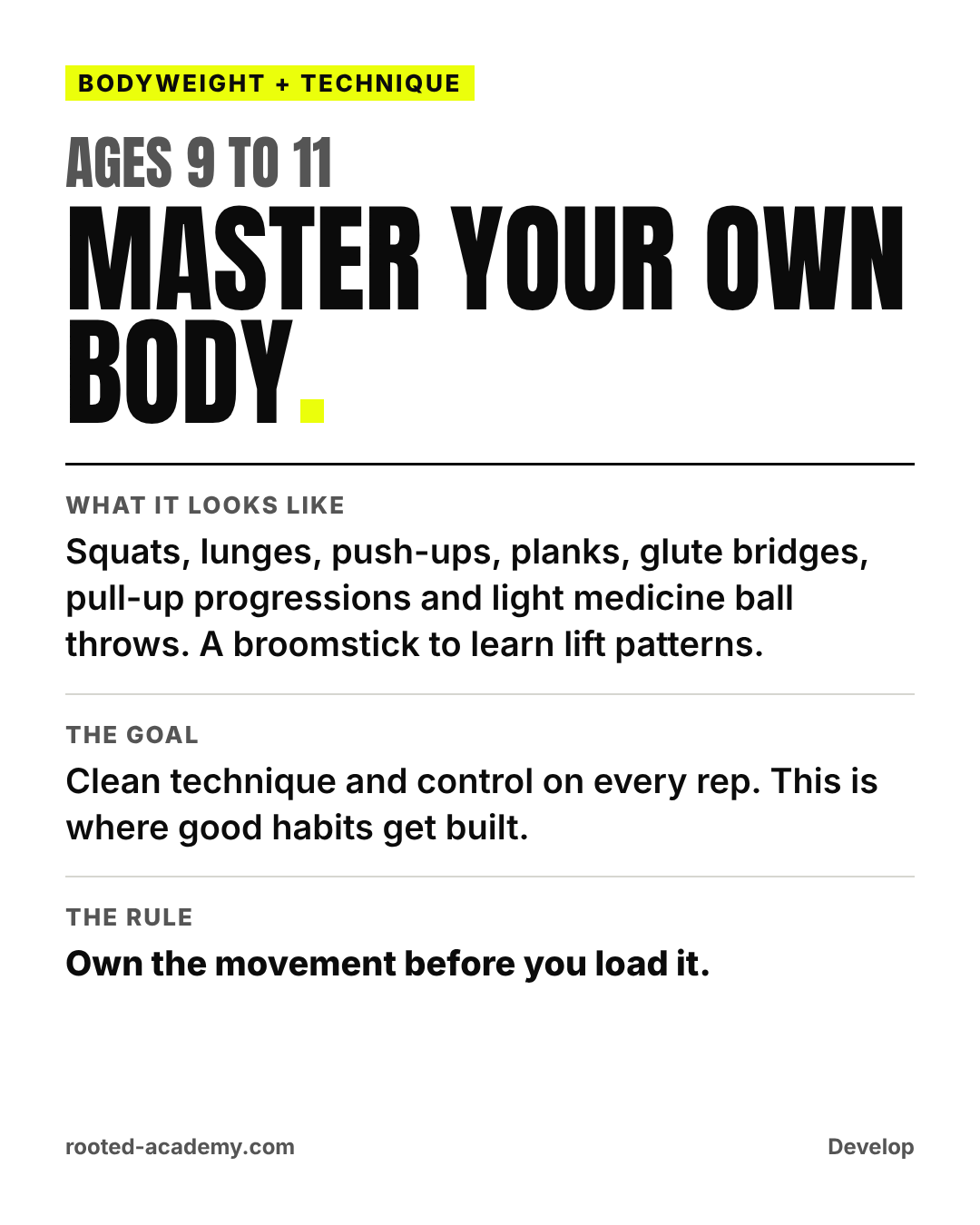
Strength for ages 9 to 11: Master your own body
PhysicalAges 9-11: Master your own bodyBodyweight and technique before load
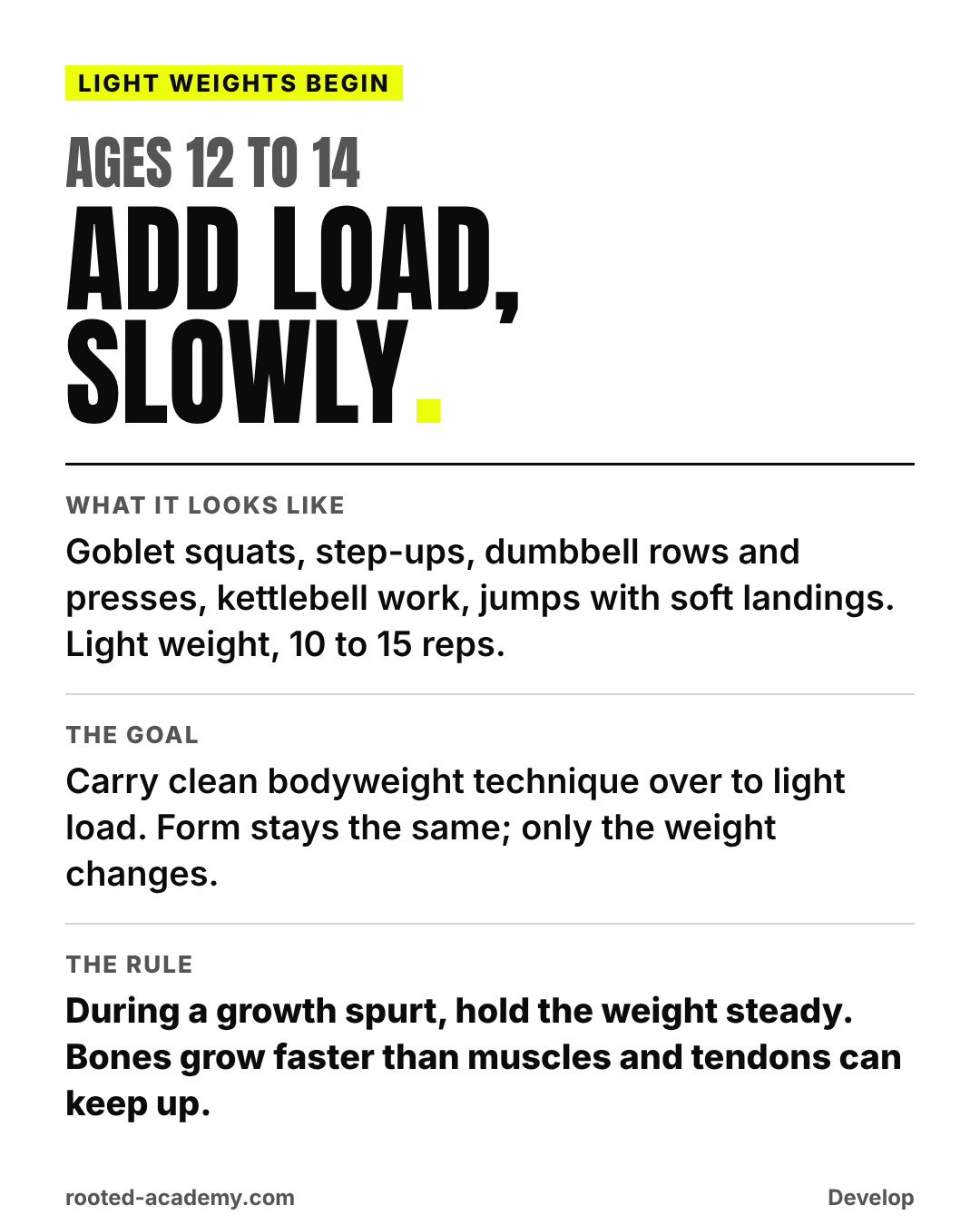
Strength for ages 12 to 14: Add load, slowly
PhysicalAges 12-14: Add load, slowlyLight weights begin, technique first
Sources: Strength

Strength

  • Faigenbaum, A. D., Kraemer, W. J., Blimkie, C. J. R., et al. (2009). Youth resistance training: Updated position statement paper from the National Strength and Conditioning Association. Journal of Strength and Conditioning Research, 23(5 Suppl), S60–S79. nsca.com
  • Stricker, P. R., Faigenbaum, A. D., McCambridge, T. M., & Council on Sports Medicine and Fitness. (2020). Resistance training for children and adolescents. Pediatrics, 145(6), e20201011. American Academy of Pediatrics. aap.org
  • National Strength and Conditioning Association. Youth performance and fitness: Strength and conditioning information for parents. nsca.com
  • American Academy of Orthopaedic Surgeons, OrthoInfo. Overuse injuries in children. orthoinfo.org
Goals (5)

Age-appropriate goal setting your athlete leads, with a tracker for any sport.
Goals by age: What a good goal looks like at each stage
MindGoals by ageWhat a good goal looks like at each stage
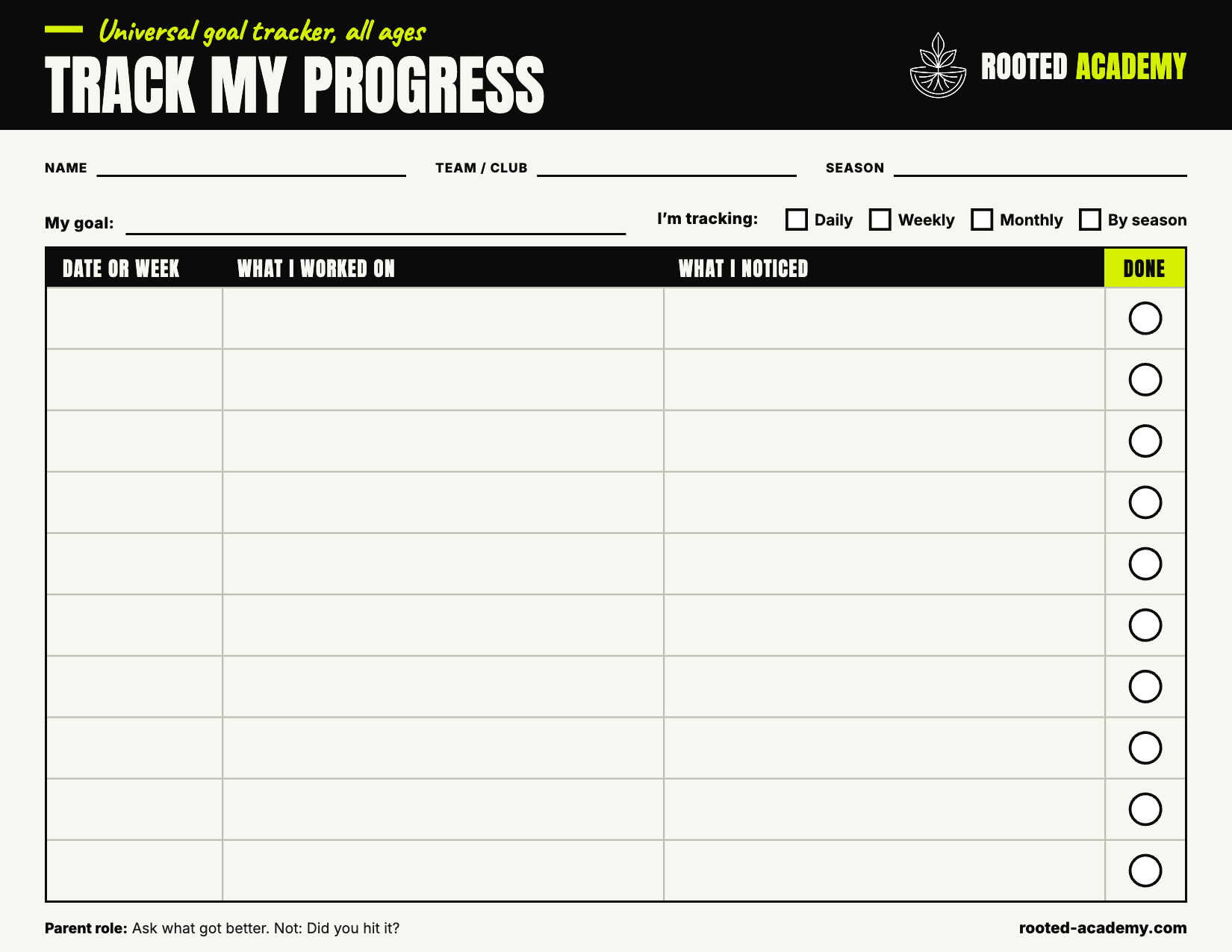
Universal goal tracker: One page for any age or sport
MindUniversal goal trackerOne page for any age or sport

Worksheets by age

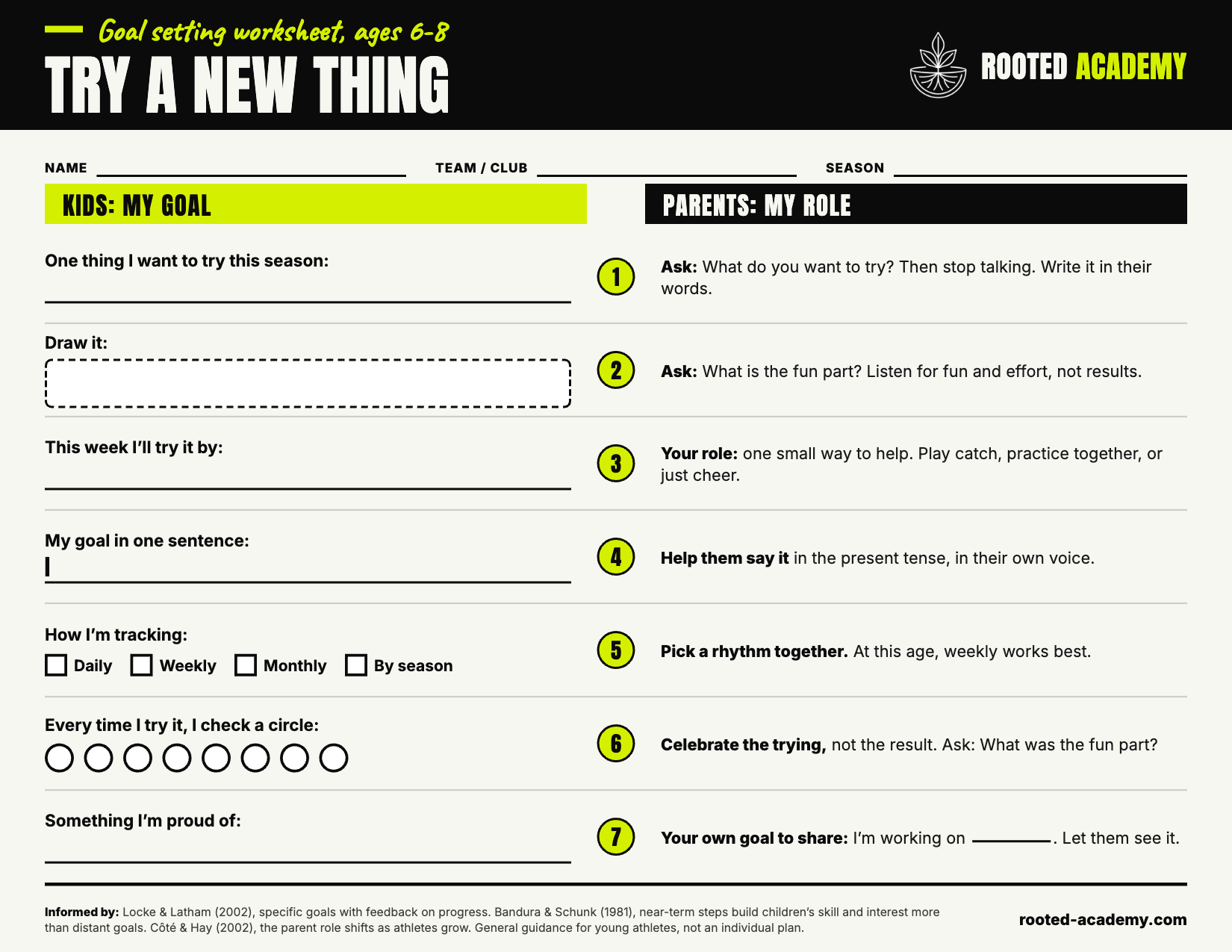
Goal setting worksheet for ages 6 to 8: Try a new thing
MindAges 6-8: Try a new thingDraw it, try it, check it off
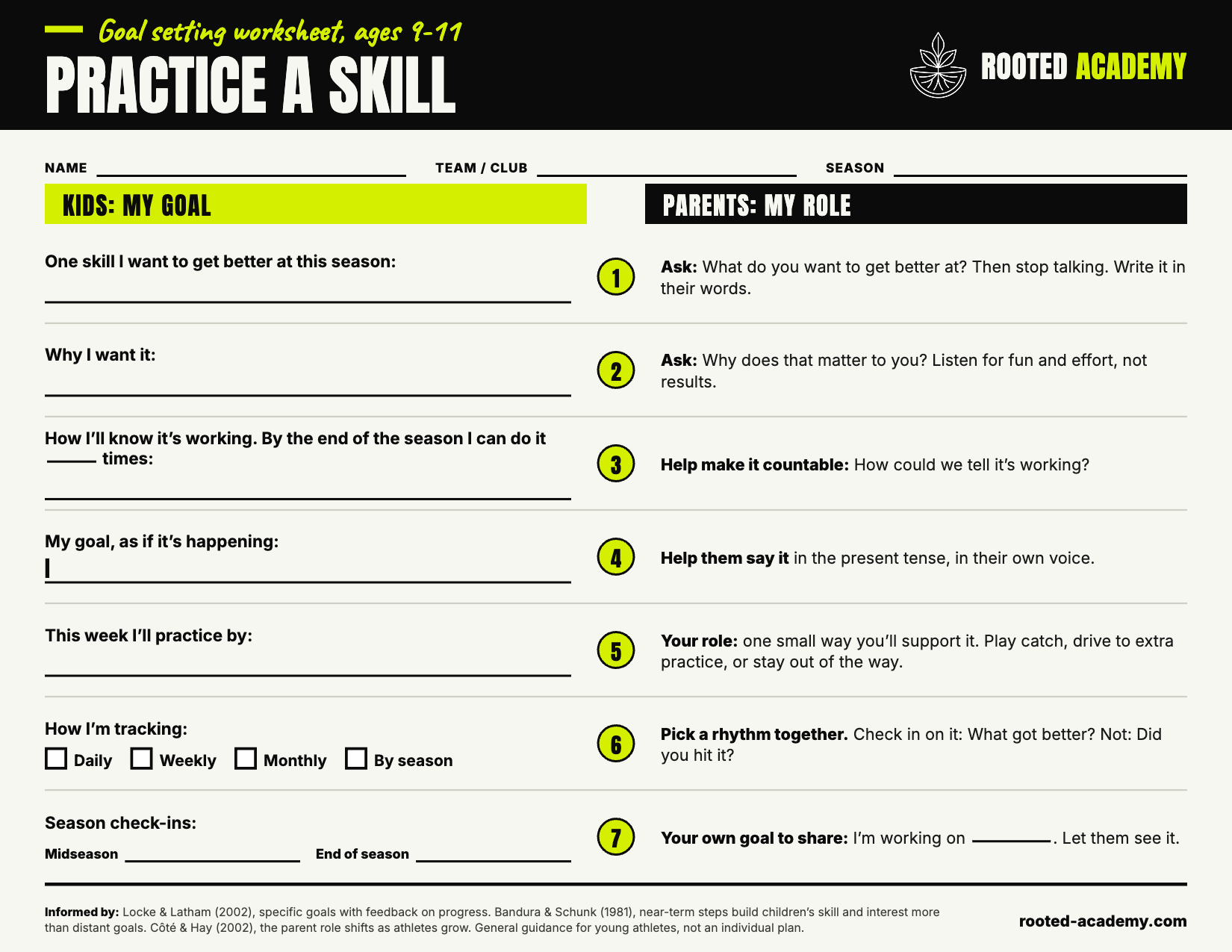
Goal setting worksheet for ages 9 to 11: Practice a skill
MindAges 9-11: Practice a skillSkill goals with season check-ins
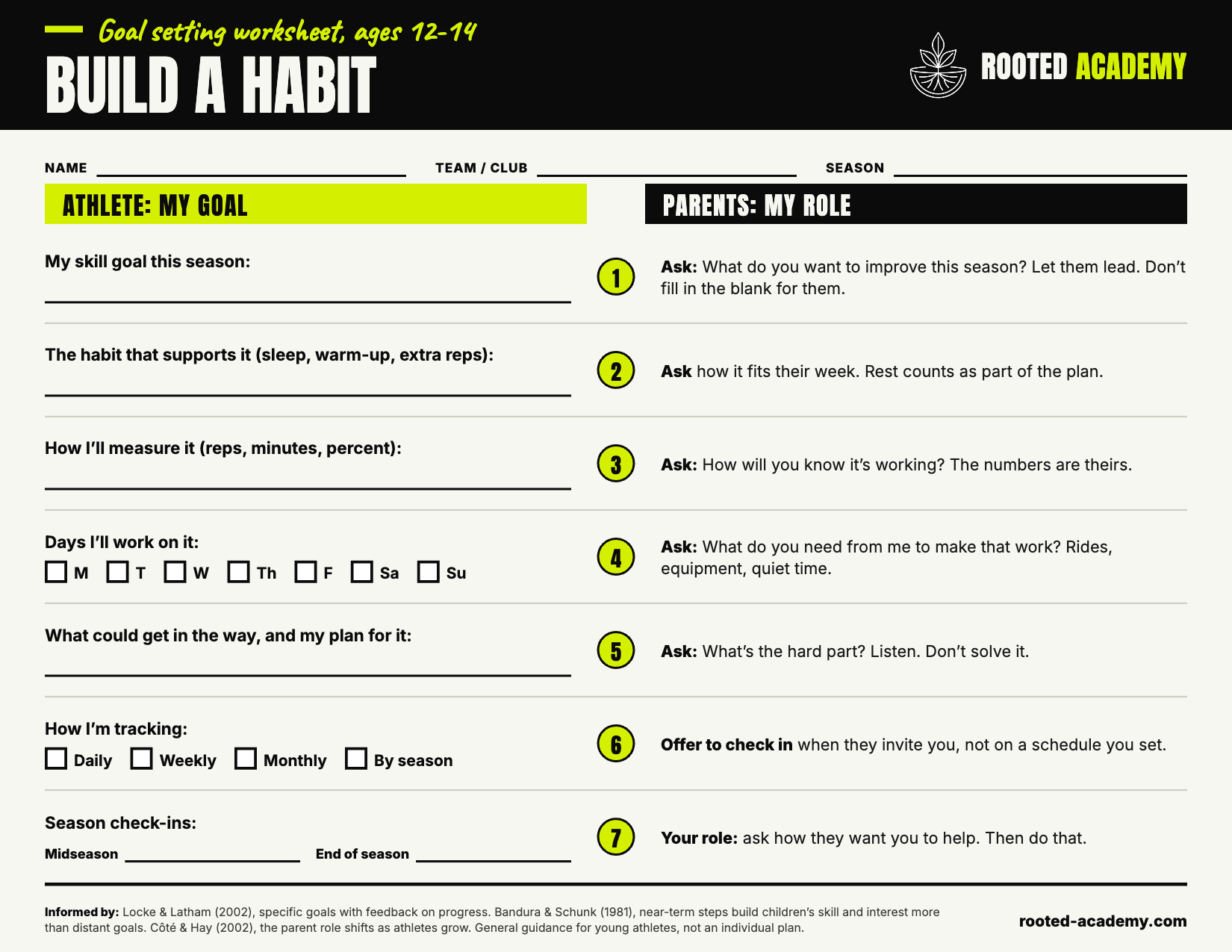
Goal setting worksheet for ages 12 to 14: Build a habit
MindAges 12-14: Build a habitA skill plus a habit, athlete-led
Sources: Goals

Goal setting

  • Côté, J. (1999). The influence of the family in the development of talent in sport. The Sport Psychologist.
  • Côté, J., & Hay, J. (2002). Children's involvement in sport: A developmental perspective. In Psychological Foundations of Sport.
  • Bandura, A., & Schunk, D. H. (1981). Cultivating competence, self-efficacy, and intrinsic interest through proximal self-motivation. Journal of Personality and Social Psychology.
  • Locke, E. A., & Latham, G. P. (2002). Building a practically useful theory of goal setting and task motivation. American Psychologist.

Coaching your athlete's team? Why kids zone out and The post-game close work at home too. Find them with the coach tools.

General guidance for young athletes, not an individual plan.

Parent Playbook

Bring a Rooted Academy talk to your team, school or parent group

Practical sessions with clear takeaways and room for questions. Virtual or in person.

Physical

Fueling the Young Athlete

Everyday fueling, game day and tournament day. Pick one track or combine them.

Led by Carrie
Physical

Growing a Stronger Athlete

Sleep, strength by age, and why more practice isn't always more progress.

Co-led with a guest expert
Mind

Confidence, Pressure & the Ride Home

Handling mistakes, setbacks and what to say (and not say) after a game.

Co-led with a guest expert
Inquire about a talk →
Stay close to it

Get what I'm learning

A short, occasional email and resource share on what I'm reading, testing, and rethinking about raising whole athletes.